One of the first questions people ask me after hearing that I have quit my corporate job, is almost always the same:
“How do you handle the stress?”
“How do you sleep at night knowing there’s no guaranteed paycheck at the end of the month?”
It’s a fair question. We’ve been conditioned to believe that a regular salary is the ultimate safety net, and that stepping away from it automatically means living in a constant state of anxiety. But after spending some time on the other side, I’ve realized something important about stress and it’s something that doesn’t get talked about enough.
In my mind, stress comes in two broad varieties:
- Stress caused by real, immediate danger
- Stress caused by imagined danger
The first kind is unavoidable and, in fact, useful. It’s the kind of stress that evolved to keep us alive. If your house is on fire, if you’re about to get into an accident, if there’s an actual threat to your survival etc. In these scenarios, stress kicks in, sharpens your focus, and helps you act. This kind of stress has a clear cause and a clear resolution.
The second kind is far more subtle, and far more damaging. This is the stress that comes from the stories we tell ourselves about the future.
What if this doesn’t work out?
What if I fail?
What if I can’t find another job?
What will people think?
What if I’ve made a huge mistake?
Dr. Robert Sapolsky explains this distinction brilliantly in one of his talks, “Why Zebras Don’t Get Ulcers.” There are both short and long versions on YouTube, do give it a look if you have the time. He gives an example that has stuck with me (paraphrasing below):
If you’re a zebra being chased by a lion and your heart rate shoots up to 180, that’s not high blood pressure, that’s survival. Your body is doing exactly what it’s designed to do.
But if you’re a human, sitting in traffic, with your heart racing to 180 because you’re going to be late for a meeting, that same physiological response becomes harmful. There’s no lion. There’s no immediate threat. Yet the body reacts as if there is.
That’s modern stress in a nutshell.
Imagined danger feels real
Don’t get me wrong, sometimes, the absence of a monthly salary can be a significant concern, especially for individuals who are still early in their careers or have substantial financial obligations.
However, I’m referring to the stress that many early entrepreneurs experience when they transition from corporate jobs after 15-20 years to venture out on their own, as I did. They still have food on the table, a roof over their heads, and their savings haven’t vanished overnight. They still possess all the skills and experience they acquired over the years that are truly valuable.
In these cases, what we’re really dealing with is imagined danger, they are kind of mental simulations of worst-case scenarios that may never happen.
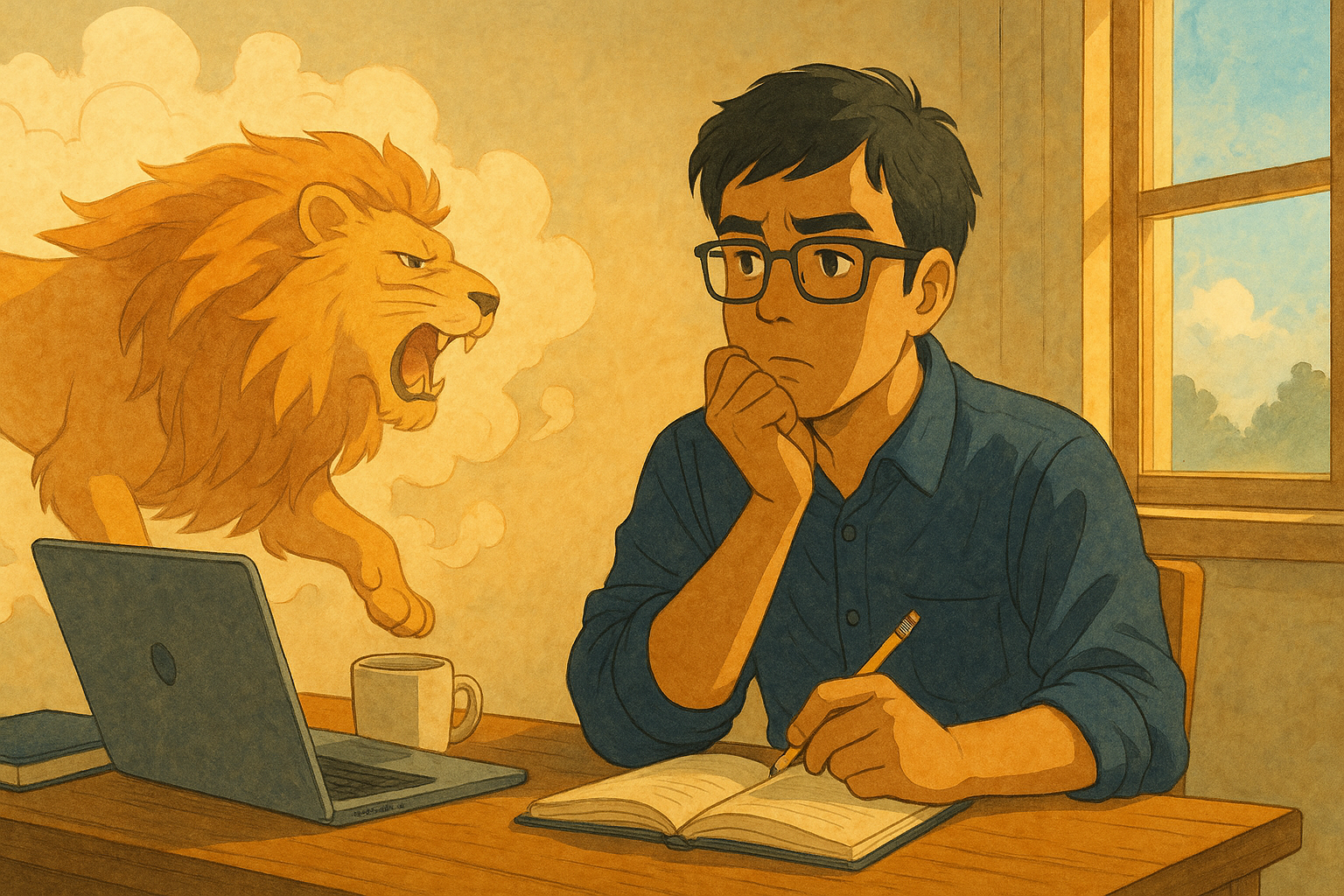
When you leave a salaried job, the “lion” your brain keeps pointing at is usually hypothetical. It lives in spreadsheets, timelines, and social expectations. And the interesting part is that your body can’t tell the difference between a real threat and a mental one.
Ironically, when I think back, I remember experiencing this same chronic stress even when I had a stable job. Deadlines, office politics, performance reviews, and fear of layoffs kept my nervous system constantly activated. The paycheck doesn’t really eliminate stress, it just changes the flavor of the stories we worry about.
Managing Risk, A simple mental check that helps
Over time, I’ve realized that learning to separate actual risk from imagined risk is one of the most important skills you need when you step off the conventional path. We need to train our minds not to live in a permanent fight-or-flight mode triggered by imagined threats.
So, the immediate concern for me isn’t finding answers to questions like “How do I make money fast?” or “How do I build a unicorn?” but rather, “How do I stop my mind from inventing lions where none exist?”
This doesn’t mean uncertainty should be ignored or romanticized. Saving wisely, planning your runway, and fiscal responsibility still matter. If you take on too much risk without proper mitigation, there’s a very real chance things may turn against you. For ex, quitting your job without planning your finances in advance can easily lead to severe burnout if your startup doesn’t gain enough traction. ¯ What I’m trying to say is this: there’s a big difference between calmly managing risk and torturing yourself with imagined catastrophes that haven’t arrived and may never arrive.
What’s helping me, albeit to some extent, is forcing a small pause when the anxiety kicks in and asking myself a very basic question:
Is this an actual problem I need to deal with right now, or am I just spinning a story about the future?
If it’s a real problem, ex: money in the bank is genuinely running low, or the market for the product I’m working on disappears etc, there’s usually a practical next step. Cut an expense, pivot, apply for a job, ask your friend for a referral etc. Do something that improves the situation.
But a lot of the time, I realize there’s nothing immediate to act on. It’s just my brain jumping a few months ahead, imagining worst-case scenarios, and reacting as if they’re already happening. In those moments, I try to remind myself that feeling scared doesn’t automatically mean I’m in danger. It just means my mind is trying (sometimes over-enthusiastically) to protect me.
I want to add that, this simple check doesn’t magically remove the stress, but it stops me from treating every anxious thought like an emergency. And more often than not, that’s enough to get me back to work instead of being stuck in my head.
And each day, I’m getting a little better at spotting imaginary lions before they trigger a full-blown survival response. For now, that feels like progress !