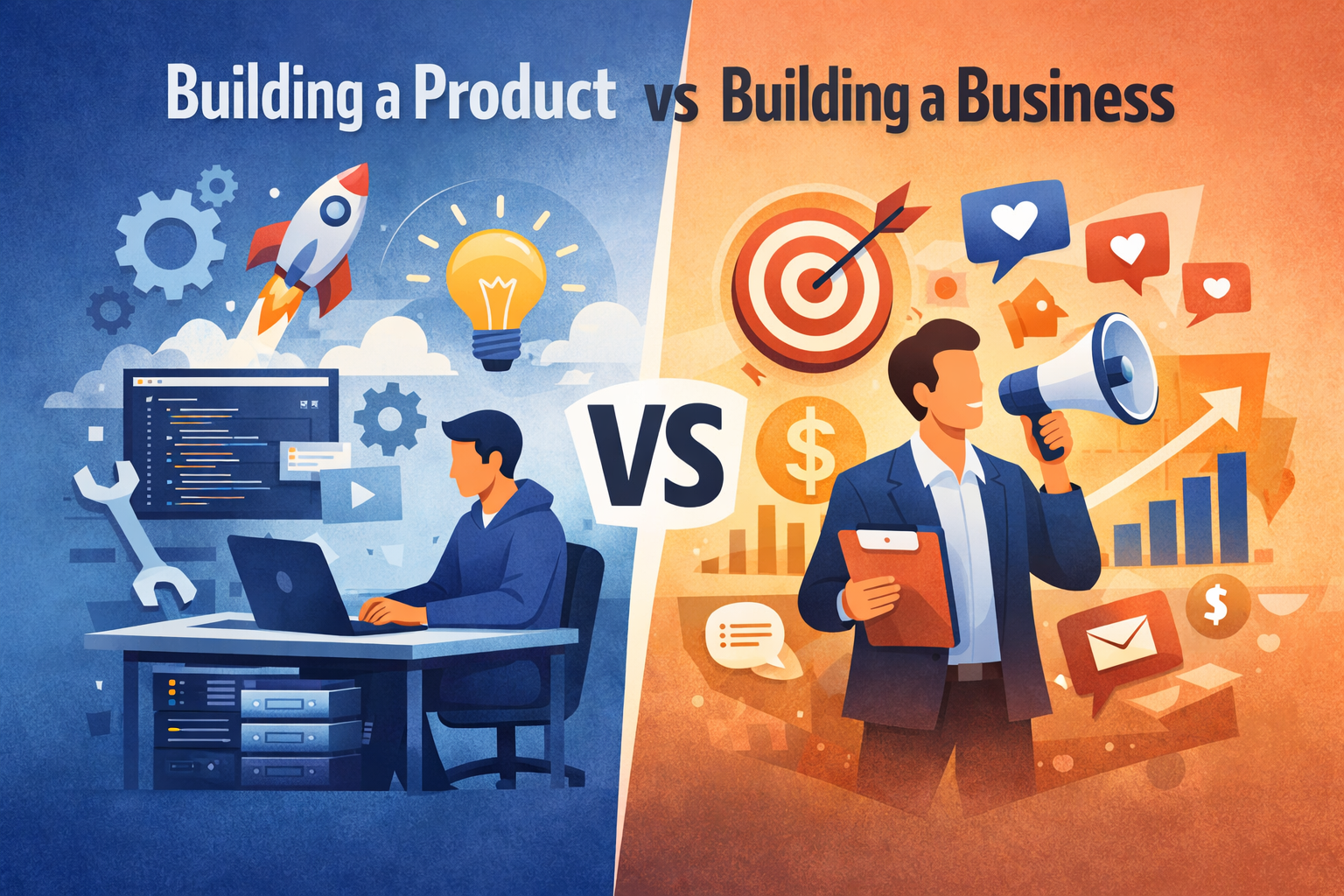
I always knew there was a difference between building a product and building a business. If you are active in indie builder communities on Twitter, you keep hearing the phrase “Building is the easy part” almost every other day. Although I had heard this many times before, I didn’t truly understand the magnitude of that difference until I dove in head first.
Before I started, my mental model was simple and, honestly, quite reasonable. I assumed it would be roughly a 50–50 split. Half my time would go into building, and the other half into everything else: marketing, distribution, talking to users, selling, and learning how to package the product properly. I was prepared for that trade-off.
What I wasn’t prepared for was how wrong that ratio would turn out to be.
Creation Is No Longer the Bottleneck
In today’s world, building a good product is no longer rare. The tools are powerful, cheap, and accessible. A solo developer can ship something in weeks that would have taken a funded team months a decade ago.
AI, frameworks, templates, and cloud infrastructure have dramatically compressed the cost of creation.
The problem is that creation is no longer the bottleneck. Attention is.
We now live in a market flooded with options. For almost any problem you try to solve, there are dozens, sometimes hundreds, of existing tools. Many are decent. Some are excellent. A few are aggressively marketed.
In this environment, shipping a solid product doesn’t mean much if you cannot get it in front of users and somehow convince them to try it.
Convincing them to pay for it is orders of magnitude harder.
The Ratio Is Not 50–50
That’s when the uncomfortable realization hit me.
The split isn’t 50–50.
It’s closer to 20–80, heavily tilted toward the non-building side.
Things like:
- Distribution
- Positioning
- Storytelling
- Building trust
- Repetition
Explaining why the product exists, who it’s for, and why someone should care right now instead of later.
These things dominate your time, not because they’re optional, but because without them the product might as well not exist. Nobody would know about it.
Why This Is Hard for Builders
This is especially hard for ex-corporate developers (like me) because progress in these areas is invisible and slow. When you code, or you ship a feature in a big company, you immediately see the result. I remember being glued to app insights on Azure analyzing incoming traffic & wondering if my code caused any regressions.
When you market, you write a post, hit publish, and nothing happens. No error logs. No compile failures. Just silence.
And silence is psychologically brutal.
There is also an identity conflict at play. Most builders enjoy the sense of control that comes with building. Marketing and selling force you into uncertainty. You are exposed. You are judged. You can do everything “right” and still not get traction. That lack of determinism is deeply uncomfortable if you are wired like an engineer.
But the most uncomfortable truth in business, and honestly in life, is that avoiding something does not make it go away.
Product vs Business
Building a product is an act of creation. You optimize for functionality. Building a business is an act of communication. There is no neat optimization problem here. You throw your cards into the wind and hope someone catches them. And as much as you may dislike admitting it, when you are building a business, one without the other is incomplete.
Hope Is Not a Strategy
This doesn’t mean building is not important. A product that is not great will eventually fail, no matter how well it is marketed. But when you are just starting out, especially as a solo founder, the biggest challenge is not bad code or missing features. It is quietly building something and hoping that quality alone will carry it forward.
It won’t. As Jeff Bezos famously said - “Hope is not a strategy.”
In other words, you need a digital microphone.
You need to figure out a way to consistently reach and engage your target audience. It’s not enough to simply announce your product, you have to communicate its value clearly and convincingly, cutting through the noise of countless alternatives. Your message must resonate, stand out, and make people care enough to pay attention.
Redefining Progress
The real shift for me has been accepting the underlying “uncertainty” inherent in some of these tasks and acknowledging that it’s often a crucial part of building a business. Stuff like writing, sharing, repeating yourself, talking about the same idea in ten different ways might not feel productive or progress at the moment, but that is the work that determines whether your product ever gets a chance.
If you are a builder transitioning into entrepreneurship, this is not meant to discourage you. It is simply a recalibration of expectations. The challenge is not that building a business is harder than building a product. It is that it requires different skills, different patience, and a different definition of progress.
Once you internalize that, the frustration might ease up a bit.